


Governor Carney 'Fiscal' Success Isn't


Governor Carney 'Fiscal' Success Isn't
By Charlie Copeland, Director
Center for Analysis of Delaware's Economy & Government Spending
May 4, 2023
"Accidents will happen; we only hit and run I don't wanna hear it, 'cause I know what I've done." - Elvis Costello
In a recent article published by the Delaware State Chamber of Commerce, Rick Geisenberger, Delaware's Secretary of Finance, wrote:
"The State's fiscal condition is arguably in its best shape in decades - a far cry from the $400 million budget deficit facing Delaware when Governor Carney took office in 2017.
It's no accident."
His first sentence is accurate; however, the second sentence is not. Without Federal COVID-19 money, the State would be in crisis.
History Repeats Itself
Graph 1.0 below shows Delaware's year-end (YE) fiscal cash position during the last three governors' terms (Minner, Markell, and Carney). It also reveals a "deficit-tax-spend-deficit" repetitive process that restarts every time a Governor first enters office. That cycle is:
#1 A new Governor comes into office;
#2 The State experiences a budget deficit;
#3 The Governor increases taxes;
#4 The Governor increases spending, and the cash runs out by the end of their term;
#5 Go back to step 1.
GRAPH 1.0: Minner vs. Markell vs. Carney

(Source: Delaware Department of Finance from 2002 through 2022.)
Notice that Governor Carney has broken this "repetitive process" accidentally after entering office in 2017. He came in with a shortfall (#2) and raised taxes like his predecessors (#3). Spending started to ramp up (#4), but as a result of COVID-19, the Trump and Biden administrations poured additional billions of dollars into Delaware, leading to a dramatic, but accidental, rise in cash in 2021 & 2022, thereby breaking the trend.
However, please note carefully Delaware is NOT in a strong operating condition - but only a strong cash position. Delaware's economy is in shambles, with a State GDP that is 8.7% smaller today in constant dollars than when Governor Carney entered office (See Graph 2.0).
GRAPH 2.0: Carney Administration 2017-2022

(Source: Author's own calculations based on St. Louis Federal Reserve GDP & Consumer Price Index.)
'Sustainable' Spending Growth
Delaware's Secretary of Finance Geisenberger further touts the Governor's "budget growth at economically sustainable levels" by defining a 7.4% growth level as "sustainable."
Including his proposed 7.4% spending growth for next year, Governor Carney has INCREASED spending at 2.5 times the rate of the previous gubernatorial administration (see Graph 3.0).
As importantly, the last three years (2020-2022) have been the LARGEST 3-year spending increases in State history on a cash basis and a percentage basis.
GRAPH 3.0: Minner vs. Markell vs. Carney
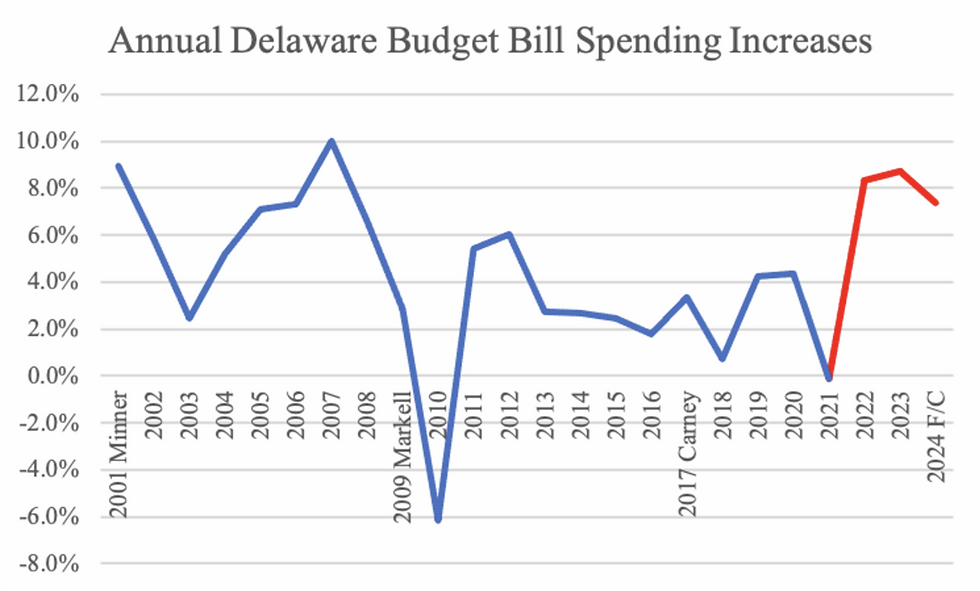
(Source: Delaware General Assembly Annual Budget Bills and Supplemental Spending Bills from 2002 through 2013.)
Conclusion
Fiscally, Delaware has benefitted accidentally due to COVID-19. With billions in one-time Federal money, the State's fiscal condition appears to be strong. However, when you look at how much spending has increased in the past three years, combined with the decline in GDP, it is clear how troubling the State's operating condition really is.
Once the COVID-19 "relief funds" money stops flowing, where will Delaware's next Governor get more money? Go back and look at the 5-step "repetitive process" mentioned previously for the answer.
True economic growth is not accidental. True economic growth requires a "light touch" from the government in taxes and regulations. A light touch is missing in Dover... And that is no accident.



Comments