


Delaware's Corporate Franchise Revenue No Longer Plugs The Gap

Updated: Jul 29
Delaware doesn't have a revenue problem—it has a spending problem.
The state's largest source of revenue, its corporate franchise, has stopped growing while government spending continues to climb. Rather than confronting that reality, lawmakers have turned to higher business taxes and fees to close the gap. Delaware's own financial data tell the story and serve as a warning.
For decades, the State of Delaware's role as the nation's incorporation capital has been its biggest moneymaker. Taxes and fees paid by companies that register here — the "corporate franchise" — make up about 30% of the state's General Fund, more than any other single source. That engine has now stalled. According to the the revenue forecast issued by the Delaware Economic and Financial Advisory Council (DEFAC), franchise tax collections are projected to remain flat through 2028. The only increase comes from House Bill 400, signed into law by Governor Matt Meyer on May 21, 2026, which raised the annual tax on LLCs and partnerships from $300 to $400. Remove that hike, and the underlying revenue isn't just flat; after inflation, it is shrinking — even as state spending keeps climbing more than 5% a year.
What's worrying is that Delaware isn't losing companies — it's gaining them. Delaware Division of Corporations statistics show a 25.4% increase in total business entities since 2021, while franchise tax revenues are about 6% lower in real terms. Per business entity, Delaware’s revenue is down to about $807, from a 2023 peak of $904. Delaware is signing up more customers while collecting less from each one: the classic sign of a maturing franchise under real competition, not a growing one.
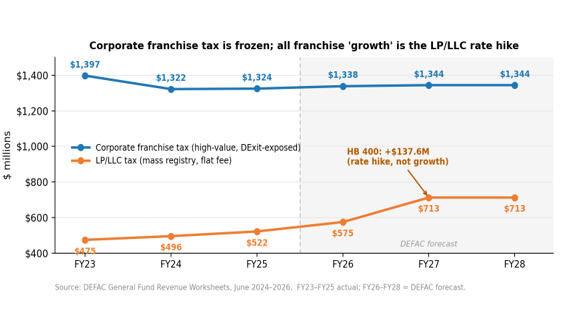
The DEFAC forecast: the corporate franchise tax revenue line becomes flat
The state’s own forecast tells the story. The blue line is the corporate franchise tax — the money large companies pay to make Delaware their legal home. For decades, it has been the state's dependable workhorse. It has stopped climbing. It slipped from just under $1.40 billion in 2023 to roughly $1.32 billion in 2024, and the state's own forecasters at DEFAC expect it to remain nearly flat — near $1.34 billion — every year through 2028. A flat line can sound stable, but after inflation it is really a slow bleed: a real decline of close to 10%.
The rising orange line represents the LP/LLC small-entity annual tax. It tracks the tax paid by LLCs and partnerships — the millions of smaller entities that owe a flat annual tax. That orange line is the sole reason the combined franchise number shows any growth, and it points directly to House Bill 400.
The House Bill 400 tax increase saves the day, but only in the short term
The FY26 jump in the orange line isn't a wave of new companies or a booming economy. It's a price increase. House Bill 400 — sponsored by Rep. Harris and Sen. Townsend — raised the flat annual tax on LLCs, LPs, and general partnerships from $300 to $400, the first increase since 2014. That change aligns almost perfectly with the roughly $137.6 million DEFAC added to its 2027 forecast.
Lawmakers were candid about why they raised the tax. As reported by WDEL News, Rep. Harris cited "a budget deficit," and the Joint Finance Committee chair, Sen. Paradee, called the hike "a responsible way to raise the revenue we need to balance our budget."
CRI sees it differently. Back in September 2024, we noted that nearly all of Delaware's major revenue sources had already flatlined in chained dollars, meaning after adjusting for inflation. The corporate franchise was the last to outpace inflation. We warned then that it, too, would stall. It has. What the state is really doing is leaning harder on its incorporation business to plug a spending gap — raising prices for its customers just as competition for those customers is heating up. Charging more for a product that other states are racing to copy isn't a "responsible" long-term plan. It's a short one.
The spending gap widens - flat revenue meets compounding spending
Even with the HB 400 rate hike, General Fund revenue still trails spending. DEFAC projects General Fund revenue to grow 4.1%, then 3.6%, then 2.0%, while Corporation Income Tax receipts fall by 24% through FY28. Only Personal Income Tax is forecast to grow about 5% annually for the next three years, but against 5%+ appropriations growth — the money the government has authorized itself to spend — the revenue/spending gap compounds (Figure 2). Strip out the additional revenue generated from HB 400, which masks part of that gap, and the true revenue/spending gap is even larger.

The solution: meeting the competition for the corporate franchise business
Delaware's real problem is spending, not revenue. Its biggest money-maker hasn't collapsed — it has simply stopped growing. Trying to fix a spending problem by raising prices, again and again, gets the diagnosis backward. And the companies being asked to pay more can simply move to states where it is more attractive.
What does “attractive” look like? Texas has spent twenty years answering that question. It charges no personal income tax, keeps its business tax low enough that many small companies owe nothing, uses a relatively business-oriented regulatory and litigation environment rather than aggressive recruiting, and lets a fast-growing private economy widen the tax base instead of taxing a fixed base more heavily. To meet its budget needs, Texas uses a 6.25% sales tax instead of an income tax. Delaware’s existing top income tax rate of 6.99% is comparable in level to the Texas sales tax.
The verdict is in the numbers: Texas was just named the best state for business (and has been in that top spot for almost 20 consecutive years) and leads the nation in corporate relocations. And more worrisome for Delaware, Texas is now coming for the franchise itself — it has opened a Business Court to rival the Court of Chancery, backers have launched a Texas Stock Exchange, and companies from Exxon to SpaceX to Dell have moved their legal home there. While Delaware raises prices, Texas is building the courthouse, the exchange, and the tax climate to welcome that same customer.
Delaware needs to attract customers, not send them to Texas.


Comments