


US Offshore Wind Jobs are Highly Exaggerated


US Offshore Wind Jobs are Highly Exaggerated
By David T. Stevenson, Director
Center for Energy & Environmental Policy
May 13, 2022
Offshore wind supporters like to quote a Wood Mackenzie research study that says building 29,000 megawatts (MW) of offshore wind electric generating capacity on the Atlantic seaboard by 2030 will create 80,000 annual full-time US jobs between 2025 and 2030.
Extrapolating from an actual approved project leads to an estimate of only about 5,500 jobs, and even that number may be high. Further, the study ignores possibly over 25,600 jobs potentially lost from huge electric premiums that redirect consumer and business spending elsewhere in the economy
The Maryland Public Service Commission (PSC) recently approved the 846 MW Skipjack 2 offshore wind project off Delaware's coast. A review[i] of the project by the PSC consultant indicates there will be 857 temporary construction jobs and 25 permanent Operational & Maintenance jobs.
The Wood Mackenzie study assumes 4,200 MW a year of new offshore wind will be constructed between 2025 and 2030, about five times the Skipjack 2 project. Table 1 below compares the Wood Mackenzie study job estimates to a number based on the Skipjack project.
Table 1: US Job Forecast Comparison
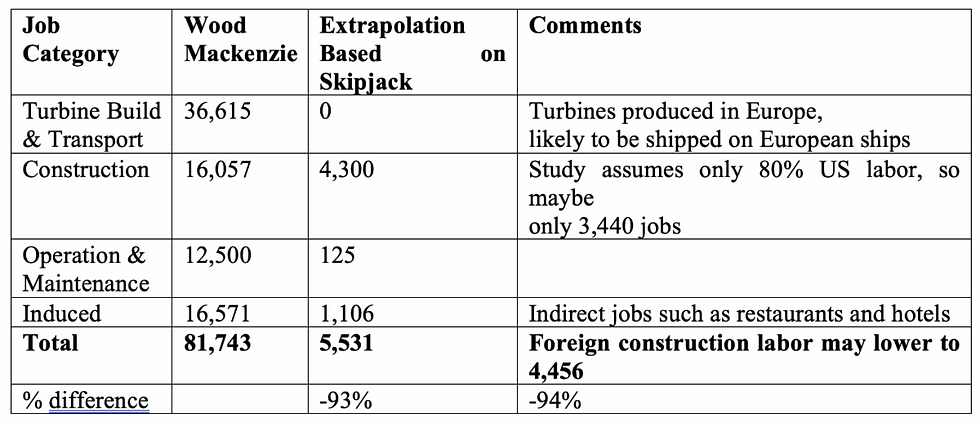
(Table source: Author's own calculations using data from 2020 Wood Mackenzie study and 2021 Maryland Public Service Commission evaluation.)
There are limited plans to build the turbines in the US, which accounts for 56% of the forecasted jobs. Induced jobs are indirect jobs created by the wages spent by direct employees and change as payroll estimates change.
The Wood Mackenzie study assumes that over half the new projects would be off the Carolinas. However, any new project needs massive state subsidies, and neither North Carolina nor South Carolina has such legislated mandated subsidies.
Money spent on higher utility bills reduces spending on everything else, like going to a restaurant or the movies.
The Skipjack project premiums[ii] will be passed onto electric customers and may average $125/MWh for the 3.3 million MWh of wind energy produced each year, or about $410 million a year. That extrapolates to $2.05 billion a year for the 4,200 MW construction the study expects. A job may be lost for every $80,000[iii] spent on higher electric bills, so up to 25,600 jobs may be lost.
Wood Mackenzie is generally reliable, but this study misses by a country mile and is misleading elected officials and the public.
[i] Maryland Public Service Commission Docket 9666, item 33, ICF International "Evaluation and Comparison of Marwin II and Skipjack Wind proposed offshore wind project applications" Exhibits 56 and 59.
[ii] ORECs represent the premium price paid for the Skipjack offshore wind power. Ørsted has reported on an OREC cost of $71.61/MWh, but this is in 2012 and is subject to a 3% a year increase for twenty years once the project starts, Ørsted media announcement.
[iii] The Balance, "Do Tax cuts create jobs" payroll tax data shows a job gained for each $76,923 in tax cuts ($1,000,000 =13 jobs); Beacon Hill Institute, "The proposed Massachusetts carbon tax; a high-cost low benefit policy" Table 4 shows investment would fall $925 million and reduce jobs by 11,090 = $83,408 jobs.


Comments